
The pear-shaped bust concentrates its volume in the lower third of the breast, with a significantly less full upper part. This distribution imbalance creates a specific technical challenge: gaping at the top of the cup and an irregular appearance under fitted tops. Working with this morphology requires mastering the fitting beforehand and selecting cuts that embrace the natural curve rather than constraining it.
Fitting and bras for pear-shaped busts: the issue of hollow cups
The reflex to reduce the cup size to eliminate space at the top is a common mistake. A cup that is too small compresses the base, accentuates downward projection, and distorts the drape of the fabric above.
We recommend first checking that the bottom of the cup is fully filled without lateral overflow. It is the lower part that dictates the actual size. The residual space at the top is corrected by the choice of cut, not by reducing the band size.
Balcony bras with reinforced side panels support the breast without flattening the projection. A lightly pre-shaped molded cup visually fills the upper hollow and provides a smooth surface under thin tops. Knowing how to enhance a pear-shaped bust starts with this fitting step, long before choosing the garment.
The center gore also deserves special attention. On a pear-shaped bust, the natural gap between the breasts varies according to the width of the breast base. A bra where the center gore lies flat against the sternum confirms a correct fit. If the center gore lifts, the width of the underwire is inappropriate.
Necklines and top cuts suitable for pear shapes
The V-neck remains the most effective cut for this morphology. It elongates the torso, opens up the neckline, and diverts attention from the less full upper area. A moderate V (neither high neck nor plunging) creates a visual frame that follows the natural line of the breast without exposing the upper hollow.
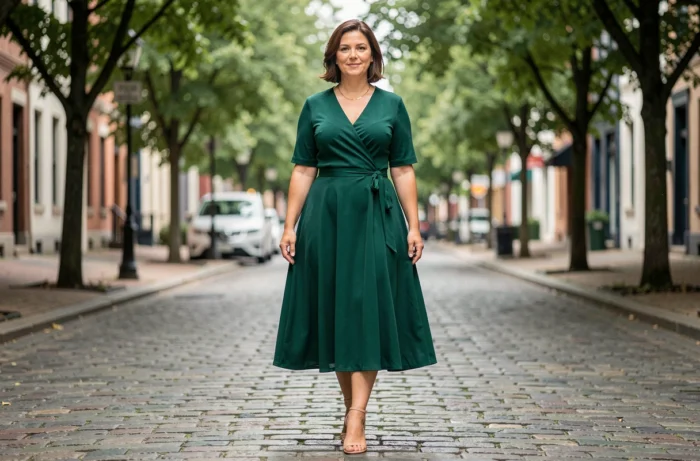
The wrap neckline works on the same principle, with an added advantage: the crossing of the fabric generates a diagonal drape that visually redistributes the volume. On a pear-shaped bust, this drape better conceals the upper/lower asymmetry than a flat fabric.
Preferred materials and thicknesses
Fluid fabrics with medium weight (viscose jersey, lightweight crepe) hug the lower curve without flattening the upper part. We observe that overly rigid materials (thick poplin, denim) create tension folds under the breast that highlight the volume imbalance.
Double-layered tops at the bust or models with bust darts allow for adjusting the depth of the garment to the actual breast projection. This is a construction detail that off-the-shelf items often overlook, but a well-placed dart radically changes the drape of a blouse.
- Avoid tops with horizontal gathers at the bust, which add volume where it is already maximal
- Prefer details placed at the top (structured collar, contrasting yoke) to rebalance the silhouette
- Exclude bandeaus and boat necklines that flatten the neckline and accentuate the upper hollow of the breast
Dresses and overall silhouette: rebalancing proportions
On a silhouette where the pear-shaped bust is often paired with pronounced hips, the choice of dress determines visual harmony. The wrap dress with a defined waist remains the most versatile cut: it structures the bust, cinches the waist, and frees the lower part with an A-line drape that does not cling to the hips.
Straight dresses and sheath cuts can work, provided the fabric has enough stretch to follow the breast curve without pulling. A fabric that is too thin or too static creases under the breast and creates an unflattering horizontal line.
Evening dresses and formal occasions
For an evening or wedding dress, we recommend corsets with integrated underwire and separate cups. These constructions offer structural support that replaces the bra and allow for working the neckline without compromise.
A corset with side boning and a lightly padded upper cup compensates for the natural hollow of the pear-shaped bust. The result under evening fabric (satin, organza) is significantly more homogeneous than with a classic bra under a fine dress.

Color, patterns, and volume play on the bust
The placement of colors directly influences the perception of proportions. A light tone or a pattern on the upper part of the bust draws the eye to the less voluminous area, which rebalances the reading of the silhouette.
We recommend color-blocking with a brighter shade above the bust line and a darker shade below. This simple contrast acts as an optical corrector without resorting to complex cuts.
- Fine vertical stripes on the bust elongate and unify the décolleté area
- Small-scale prints distributed evenly avoid creating areas of visual accumulation
- Dark monochrome blocks on the lower bust minimize the lower projection of the breast
- A contrasting collar or a décolleté jewel raises the focal point to the upper bust
The pear shape is not corrected; it is showcased. The work focuses on the fitting of the bra, the cut of the garment, and the strategic placement of visual details. A cup suited to the lower projection, a well-calibrated V-neck, and targeted color play are enough to transform the look of an outfit without multiplying pieces or accessories.