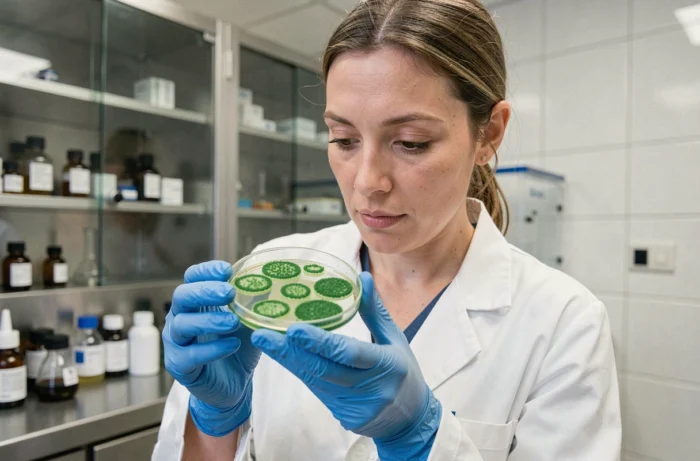
Cellular and molecular biology is undergoing a phase where artificial intelligence tools are redefining how researchers explore living organisms. Two main axes structure recent advances: large-scale computational modeling of cells and three-dimensional mapping of the genome. These discoveries are no longer science fiction; they are already feeding into concrete research pipelines in the laboratory.
Universal Cell Models: AI Applied to Inter-Species Biology
Language models have transformed text processing. An analogous logic now applies to biological data. In September 2026, teams from Stanford presented two major tools: Universal Cell Embedding and TranscriptFormer.
TranscriptFormer was trained on data from 112 million cells across 12 species, from yeast to humans. The goal: to map cellular states over approximately 1.5 billion years of evolution. This type of approach allows for the transfer of knowledge gained from a model organism (mouse, zebrafish) directly to human biology.
What differentiates this work from previous approaches is its inter-species dimension. Directly comparing the state of a yeast cell with that of a human cell was a theoretical exercise. These foundation models make the comparison operational, quantifiable, and reproducible in the laboratory. Among the latest news from Bio Geek, this shift towards universal cellular modeling is one of the most followed topics by the French-speaking scientific community.
Next-Generation Human Cell Atlases
Transcriptomic atlases serve as references for understanding which genes are active in each cell type. The update Tabula Sapiens 2.0, released in pre-publication in September 2026, offers a significantly expanded human atlas compared to the first version.
This second generation integrates dozens of tissues and offers a spatial resolution that earlier atlases did not allow. The challenge is not limited to cataloging cells: it is about understanding how cells interact in a three-dimensional space, and how these interactions vary from one organ to another.
Why 3D Changes the Game for Research
A 2D atlas provides a photograph. A 3D atlas provides an architecture. For research on diseases like cancers or autoimmune diseases, knowing where a cell is located within a tissue (and which cells surround it) radically changes the interpretation of data. Understanding how DNA folds in space to activate or repress certain genes is a central challenge of this three-dimensional approach.
AI and Drug Discovery: Accelerating Preclinical Timelines
Artificial intelligence does not just model cells. It also shortens the steps in discovering new therapeutic molecules. Several platforms now combine generative AI and molecular screening to propose drug candidates ahead of clinical trials.
The principle relies on two complementary capabilities:
- The prediction of protein structures, which allows for the identification of therapeutic targets without costly crystallography
- The generation of candidate molecules by algorithms trained on massive chemical libraries
The shift from prediction to molecule generation constitutes a paradigm change. Previous tools filtered existing databases. Current approaches create new molecules, optimized for a given target, and then test them in rapid loops.
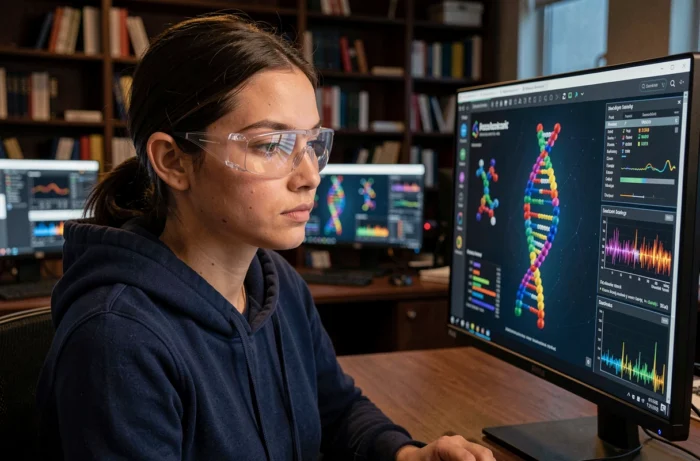
Decoding Non-Coding DNA: Rethinking the Genome
The sequencing of the human genome, completed in the early 2000s, left an open question: what are the vast regions of DNA that do not code for any protein used for? These areas, long wrongly labeled as “junk” DNA, now concentrate an increasing share of genomic research.
Recent work relies on deep neural networks to decode the regulatory grammar of non-coding DNA. These regions contain sequences that control when, where, and in what quantity a gene is expressed. Understanding this grammar paves the way for a functional reading of the genome, beyond a simple inventory of genes.
Concrete Applications in Precision Medicine
Identifying a mutation in a coding gene remains relatively straightforward. Identifying a mutation in a regulatory area, understanding its effect on the expression of a gene located sometimes very far on the chromosome, and then linking that effect to a disease: this chain of analysis requires powerful computational tools. AI models trained on multi-species data (like those from Stanford) directly feed into this type of analysis, providing cross-references between organisms.
- Genetic variants in non-coding regions represent the majority of signals detected by genome-wide association studies
- Current tools allow for the prediction of the functional impact of these variants without systematically resorting to laboratory experiments
- The combination of cellular atlas and predictive model accelerates the transition from genomic discovery to clinical diagnosis
The convergence of 3D cellular atlases, inter-species AI models, and analysis of non-coding DNA outlines a unified research framework. Each brick feeds into the others. Biology in 2026 no longer progresses discipline by discipline, but through the integration of layers of data that, in isolation, remained difficult to interpret.