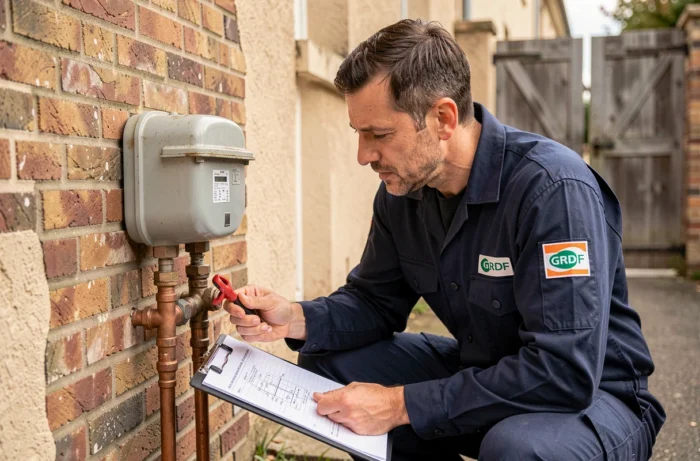
The connection of a home to the natural gas network managed by GRDF follows an administrative and technical process whose timelines and costs vary according to parameters that are rarely detailed: distance between the public pipeline and the connection box, nature of the terrain to be crossed, type of housing. Before launching a request, understanding these variables allows for anticipating the actual budget and avoiding unpleasant surprises once the work begins.
RE2020 and the 2026 decree: what gas connection still covers in new builds
Competing content presents gas connection as a universal process, without distinguishing between new and existing buildings. The environmental regulation RE2020 has profoundly changed this situation.
Since January 1, 2022, the carbon footprint ceiling (Ic energy) makes 100% gas heating impossible in new individual homes. New collective housing will be affected starting in 2025. The September 2026 decree on decarbonized heating further tightens these requirements by imposing a carbon content threshold incompatible with systems relying solely on the combustion of fossil energy.
A gas connection with GRDF remains relevant in new builds for cooking, supplementary hot water, or a hybrid system (heat pump coupled with a gas boiler). However, for the primary heating of a new construction, the connection alone is no longer sufficient to meet regulatory needs.
| Housing Situation | Gas Heating Only | Permitted Gas Uses |
|---|---|---|
| New individual house (since 2022) | Excluded by RE2020 | Cooking, hot water, hybrid |
| New collective housing (since 2025) | Excluded by RE2020 | Cooking, hot water, hybrid |
| Existing housing (renovation) | Allowed | All uses |
Timelines and process of a GRDF connection request
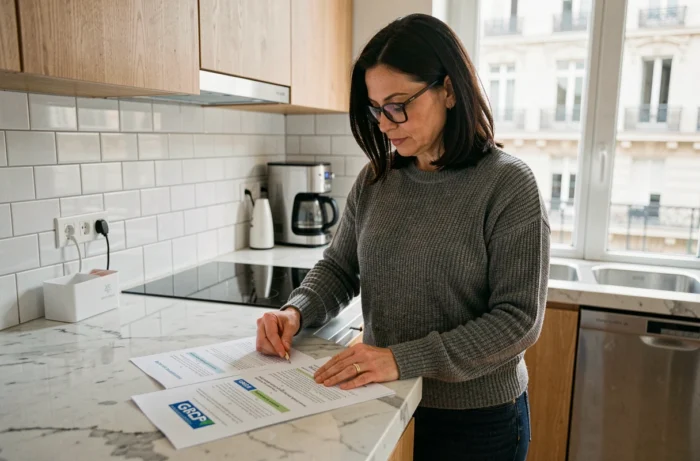
The request is made via the online form on the GRDF Customer Space. After this initial contact, the connection offer is sent by email within a maximum of one week.
Acceptance of the offer is done online: electronic signature and secure payment. In the following days, a GRDF technical contact will reach out to finalize the file and schedule the work.
What depends on GRDF and what is your responsibility
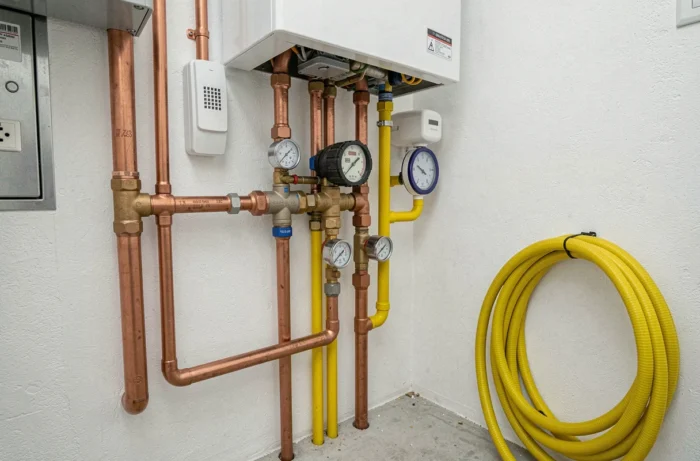
GRDF carries out the connection between the public distribution network and the gas meter installed at the property line. Everything that is after the meter is your responsibility.
- The interior installation (pipes, connections to appliances) must be entrusted to a heating plumber of your choice, holding the required qualifications.
- Subscribing to a contract with a gas supplier is necessary: it is the supplier who requests the service activation from GRDF, not the individual directly.
The service activation requires your presence at the property. GRDF recommends carrying out the steps with the supplier at least two weeks before the desired date.
Gas connection costs: the variables that affect the bill
The GRDF service catalog sets prices that depend on the configuration of the site. Competitors often list a single price, but the reality is more nuanced.
Distance to the network and nature of the soil
The main cost factor is the length of the trench between the public pipeline and the delivery point. The greater the distance, the higher the cost. The nature of the terrain (loose soil, asphalt, sidewalk) also affects the amount, as roadwork and restoration vary.
A repositioned or enlarged gas box incurs additional costs that are added to the base fee. These additional services are listed in the GRDF catalog but are not always mentioned in the initial offer if the need has not been identified.
Additional works at your expense
The GRDF quote does not cover the interior installation. The cost of the heating plumber, compliance work, and the Qualigaz certificate represent a separate budget, often comparable to the connection itself. Requesting multiple quotes from qualified PG (Gas Professional) artisans remains the most reliable method to frame this item.
Eligibility for the gas network: check before committing
Some areas of the territory are not managed by GRDF but by Local Distribution Companies (ELD) such as Sorégies in Vienne, Électricité de Strasbourg, or Gaz Électricité de Grenoble.
Before any request, check if your municipality is served by GRDF or by an ELD. The address search tool on the GRDF website provides an immediate answer. If your home is located in an ELD area, the connection procedure follows a different circuit and the rates may vary.
For an existing home already connected but with the gas cut off, the process is simpler: it is a service activation, not a connection. The chosen gas supplier then directly coordinates the intervention with GRDF. The timeline is significantly shorter than for a complete connection.
The distinction between connection (physical creation of the link to the network) and service activation (opening of the existing meter) conditions the budget, timelines, and contacts. Confusing the two remains the most common mistake in gas housing projects, whether for an individual house or an apartment in a condominium.