
In France, the majority of agricultural land is leased. However, when an owner wishes to rent a plot to a neighbor or a non-farming individual, the applicable legal framework changes drastically depending on the actual use of the land. Renting agricultural land to an individual relies on a distinction that many owners discover too late: that between agricultural activity as defined by the Rural Code and simple recreational use.
Legal qualification of the rented land: the trap that owners underestimate
Everything hinges on Article L.311-1 of the Rural Code. As soon as a piece of land is used for plant or animal production, even modestly, even on a small area, the contract automatically falls under the rural lease regime. The direct consequence: a minimum duration of nine years, rent regulated by prefectural order, and the tenant’s right to renewal.
Recent case law (2023-2026) from the Court of Cassation has clarified this boundary. Several decisions confirm that the rural lease only applies if the land is actually used for a professional agricultural activity. A recreational vegetable garden, an ornamental garden, or land used for temporary storage remain outside the status.
In practice, the search for a rental of agricultural land to an individual often goes through local word-of-mouth, but before signing anything, it is this qualification that determines the type of contract, the amount of rent, and the ease of reclaiming the property.
What triggers the status of the lease
Three cumulative elements shift a contract towards a rural lease: the provision of a property for agricultural use, a consideration (rent in cash or in kind), and effective agricultural exploitation. If any of these elements are missing, the owner has more contractual freedom.
Exchanges of enjoyment of plots between neighbors, for example, do not fall under the rural lease as long as there is no costly consideration. The loan for use (commodat) does not either, since by definition it is free. These alternatives are documented by doctrine and confirmed by recent decisions.
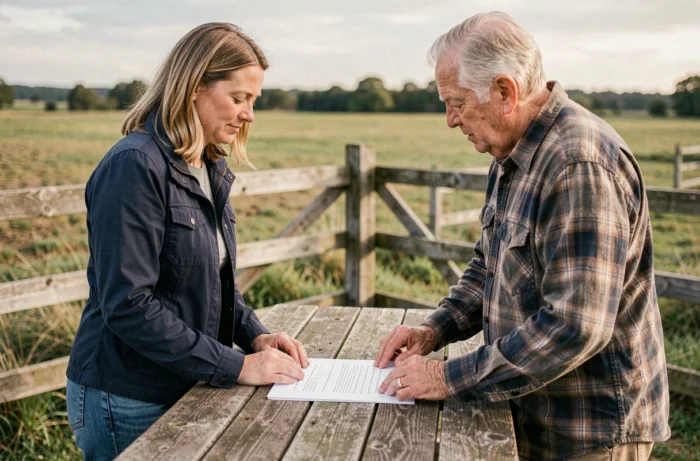
Civil contract or rural lease: what rent for a plot rented to an individual
When the land is used for pure leisure (personal vegetable garden, relaxation area), the owner and tenant freely negotiate the duration and price. A common civil contract applies, without prefectural regulation of the rent.
For small areas rented to non-farming individuals, the rents charged often exceed the equivalent rental rate per hectare. The explanation lies in the nature of the use: small plots, close access, and personal use justify a higher price than that of land for large-scale farming.
On the other hand, if the tenant starts selling their production at a local market or developing a small-scale market gardening activity, the contract can be reclassified as a rural lease by the rural lease tribunal. This reclassification applies retroactively, with all the protections of the lease status.
Precarious occupation agreement and SAFER provision agreement
Two intermediate formulas exist for owners who want to rent temporarily without committing to nine years:
- The precarious occupation agreement, justified by particular circumstances (land awaiting sale, communal development project). It must be based on a real and verifiable reason; otherwise, it will be reclassified as a rural lease.
- The provision agreement (CMD) via SAFER, which allows renting for a duration of up to six years, renewable once. SAFER finds the operator, guarantees rent payment, and returns the property free at the end of the contract.
- The commodat (free loan for use), suitable when the owner simply wants to have their plot maintained without receiving rent. No risk of reclassification as a rural lease since there is no financial consideration.
Operating authorization and right of preemption: two checks before signing
Renting agricultural land to a professional operator, even on an individual basis, may trigger the obligation to obtain an operating authorization from the DDTM (Departmental Directorate of Territories and the Sea). This authorization is required beyond certain surface thresholds, which vary by department.
An individual renting for a personal vegetable garden is not subject to this obligation. The distinction once again relies on the nature of the activity conducted on the land.
Another often overlooked point: in the event of a subsequent sale of the land, the tenant holding a rural lease has a right of preemption. SAFER can also exercise its own right of preemption. An owner who rents under a rural lease thus loses some of their freedom to sell to whomever they wish.
Drafting the rental contract: clauses not to be overlooked
Regardless of the applicable regime, a written contract remains the best protection for both parties. Verbal rural leases exist legally, but they significantly complicate proof in case of dispute.
For a rental to an individual outside the status of the lease, the contract must specify:
- The exact designation of the plot (cadastral references, area, municipality).
- The authorized use of the land, formulated restrictively to avoid any reclassification (for example: “exclusive use as an ornamental garden, any agricultural production activity for commercial purposes is prohibited”).
- The duration of the contract and the conditions for termination, including notice.
- The amount of rent, its periodicity, and its adjustment terms.
- The distribution of charges: routine maintenance, property tax, insurance.
An entry inventory, even a brief one, protects the owner against damage and the tenant against unfounded claims at the end of the contract.
Should you go before a notary
For a rural lease of more than twelve years, publication at the land publicity service is mandatory, which implies a notarial deed. For leases of nine years or simple civil contracts, a private deed is sufficient. Field feedback varies on this point: some owners prefer a notarial deed even for a short lease to secure the certain date of the contract and avoid later disputes.
The boundary between leisure rental and rural lease remains the central point of vigilance. A well-drafted contract, with a clearly defined use and precise cadastral references, constitutes the best guarantee for an owner renting their plot to a neighbor or an individual without wanting to engage in the lease regime.