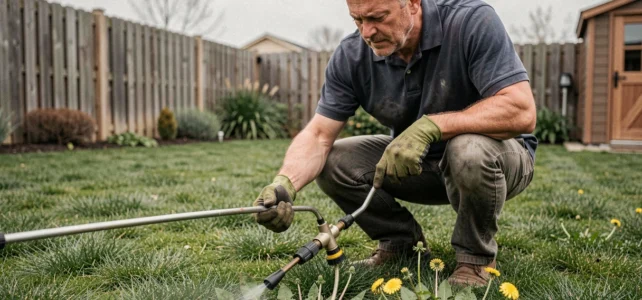
The selective treatment of lawns is based on a simple principle: eliminate weeds without destroying the grasses that make up the lawn. Since the regulatory overhaul of 2022, the products usable on a private lawn in France are limited to three categories (biocontrol, low risk, products usable in organic farming), whether the applicator is a private individual or a professional. This framework changes the way each step of the treatment must be considered.
Regulatory status of the product: the filter before any technical choice
Before questioning the active molecule or the mode of application, the first step is to check the regulatory status of the product. Since July 1, 2022, the prohibition applies to the treated area, not just the user. A lawn located on private residential property cannot receive any synthetic plant protection products, even if applied by a landscaper holding a Certiphyto.
The only authorized products fall under biocontrol, low-risk substances, or products usable in organic farming. On the label, the mention EAJ (Authorized Use in Gardens) confirms this compliance. A classic selective herbicide based on 2,4-D or dicamba, still widely sold in other European countries, is therefore outside the legal framework for a residential lawn in France.
Several online guides continue to recommend synthetic products without mentioning this restriction. Checking the market authorization number (AMM) on the official catalog of authorized plant protection products remains the most reliable method to ensure that a selective treatment is truly usable at home. The detailed protocols available on the Agrisystems.net website for your lawn incorporate this regulatory check from the very first step.
Soil diagnosis and weed identification before selective treatment
Applying a selective treatment without precisely identifying the plants to eliminate is akin to treating blindly. Weeds present in a lawn often indicate a soil imbalance that the product alone will not correct.
Reading weeds as indicators
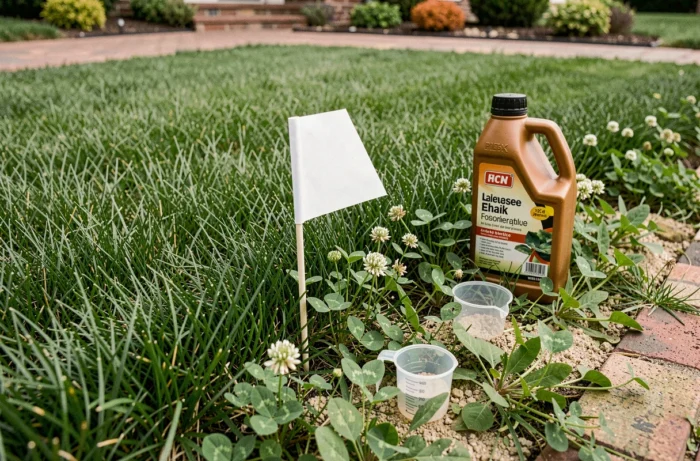
White clover often signals nitrogen-poor soil. Plantain thrives in compacted soils. Moss establishes itself when the pH is acidic and drainage is insufficient. Identifying the dominant weed guides both the choice of product and the cultural corrections to be made in parallel.
A biocontrol product targeting dicotyledons will have no effect on annual bluegrass, which is itself a grass. If the lawn is overrun by undesirable grasses, the chemical selective treatment reaches its limits, and manual removal or reseeding becomes the only realistic options.
Soil analysis: pH and structure
A pH test with a basic kit (available at garden centers) is sufficient to guide decisions. Soil with a pH below 5.5 promotes moss at the expense of grasses. Correcting acidity through liming before the selective treatment improves the lawn’s ability to recolonize areas freed by dead weeds.
- pH below 5.5: liming recommended several weeks before any selective treatment
- Compacted soil (screwdriver test: resistance to penetration): aeration by coring before application
- Sparse lawn with more than one-third bare soil: reseeding with seeds suitable for the local climate, delaying sowing by at least three weeks after treatment
Application window and weather conditions for a selective lawn treatment
The application schedule weighs as much as the choice of product in the success of the treatment. Weeds must be in a phase of active growth to effectively absorb the substance.
Spring, between mid-April and the end of May, remains the most favorable period in most French regions. Soil temperatures then regularly exceed the thresholds necessary for weed activity, and the grasses in the lawn are vigorous enough to quickly recolonize the gaps left by the eliminated plants.
Autumn (September-October) is a relevant alternative, particularly for perennial weeds that accumulate reserves in their roots before winter. In contrast, treating in the height of summer during intense heat or drought poses a double risk: burning the already stressed lawn and reduced absorption by dormant weeds.
- Ideal temperature at the time of application: mild day, with no frost expected in the following nights
- No rain expected for at least 24 hours after application, to avoid leaching of the product
- No wind beyond a light breeze, to limit drift towards flower beds or the vegetable garden
- Slightly moist soil (morning dew or light watering the day before): promotes foliar penetration
Lawn preparation and application method
Mowing before treatment plays a often underestimated role. Mowing three to five days before application, not the day before, allows weeds time to redeploy enough leaf surface to absorb the product. A close mow just before treatment reduces the contact surface and decreases effectiveness.
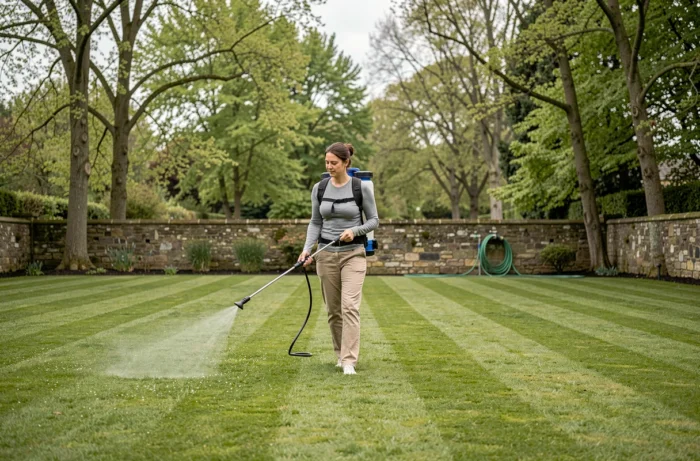
For liquid products, a pre-pressurized sprayer with a flat jet nozzle ensures even distribution. Granular formulations require a rotary or gravity spreader, calibrated according to the dosage indicated on the packaging. Strictly adhering to the prescribed dosage protects both the lawn and the environment: overdosing does not kill weeds better; it stresses the grasses.
After application, do not mow for at least a week. This delay allows the product to migrate to the roots of the weeds. The first watering or rain after the dry period of 24 hours restarts the process without compromising effectiveness.
Post-treatment follow-up and lawn reseeding
Visible results generally appear between one and three weeks depending on the type of weed and the temperature. Annual dicotyledons (veronica, chickweed) yellow quickly. Tap-rooted perennials (dandelion, dock) may require a second application spaced four to six weeks apart.
The areas left bare after the disappearance of weeds must be reseeded to prevent recolonization. Sow grass seeds suitable for the soil and sunlight within three to four weeks following treatment. A starter fertilizer rich in phosphorus promotes the rooting of young seedlings.
The success of a selective treatment is measured over the entire season, not just the days following application. A dense and well-nourished lawn remains the best barrier against the return of weeds, well beyond the effect of the product itself.