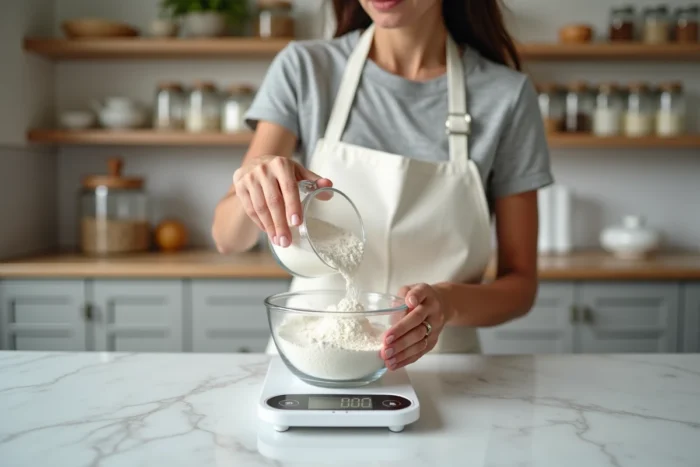
You are following a recipe that calls for 100 g of flour, but you only have a measuring cup graduated in milliliters. The scale is broken or simply missing from the drawer. This situation drives thousands of people every day to search for how to convert 100 g into liters. The answer lies in one word: density. Without it, converting weight to volume is just guessing.
Mass and volume: two quantities that cooking often confuses
A gram measures weight. A liter measures space occupied. These two quantities do not describe the same thing, yet they are constantly mixed up in the kitchen.
The confusion comes from water. Under standard conditions (temperature close to 4 °C, normal atmospheric pressure), one gram of water corresponds exactly to one milliliter. This perfect equivalence has ingrained the idea that grams and milliliters are interchangeable. For water, this is true. For everything else, it is false.
Take 100 g of honey. Honey is significantly denser than water: these 100 g occupy less space than a deciliter. Conversely, 100 g of oatmeal fills a much larger volume because the flakes are light and trap air. The same weight can yield very different volumes depending on the ingredient.
To know precisely how to convert 100 g into liters, you need to know the density of the product you are handling. No shortcuts possible.
Conversion formula from grams to liters: the calculation in one line
The formula is easy to remember:
Volume (in liters) = Mass (in grams) divided by (density multiplied by 1000)
The density (or specific weight) is expressed in g/ml. It indicates how much one milliliter of a given substance weighs. For water, the density is 1. For oil, it is around 0.9. For honey, it exceeds 1.4.

Do you have 100 g of olive oil? With a density of about 0.92, the calculation gives: 100 / (0.92 x 1000) = 0.108 L, or about 108 ml. Your 100 g of oil therefore occupies a volume slightly greater than 100 ml.
For 100 g of whole milk (density close to 1.03), you get about 97 ml. The difference from water is minimal, but it exists.
Why multiply the density by 1000?
The density is given in grams per milliliter. One liter contains 1000 milliliters. Multiplying by 1000 serves to convert the result directly into liters rather than milliliters. If you prefer to obtain milliliters, simply divide the mass by the density, without multiplying by 1000.
Density of common ingredients: where to find the right value
The calculation is easy. The real difficulty is finding the reliable density of the product. Several sources exist, but they are not all equal.
- The product packaging sometimes mentions the specific weight or net weight for a given volume. This is the most reliable source for industrial products (creams, plant milks, syrups).
- Official nutritional composition tables provide reference densities for raw foods (flour, sugar, oil, melted butter).
- Recent online converters directly integrate the specific density of each ingredient. You select your product, enter the quantity, and the tool does the conversion. This approach significantly reduces errors compared to generic tables.
Avoid “kitchen” tables found randomly on the web. Many round densities or use average values that do not correspond to your specific product. Almond milk and cow’s milk do not have the same density, and agave syrup differs from maple syrup.
Common conversion errors and how to avoid them
The most common mistake is treating all ingredients as if they were water. Applying the ratio 1 g = 1 ml to flour or powdered sugar distorts the recipe visibly. For flour, 100 g represents about 160 to 180 ml depending on the packing, which is almost double the volume that 100 g of water would occupy.
The inversion between milliliters and liters is another frequent source of error. Educational resources identify this confusion (forgetting to divide by 1000, or doing it twice) as one of the main causes of recipe failure or mishandling in practice.
The trap of powdered ingredients
Powders pose an additional problem: their density varies depending on the packing. Sifted flour occupies more volume than flour packed in a compressed bag, for the same weight. Two solutions to limit the error:
- Always aerate the powder before pouring it into the graduated container, to reproduce the standard conditions of density tables.
- Prefer the scale when possible. Weight remains more reliable than volume for powders.
- In the absence of a scale, use a converter that offers the specific density of the ingredient (wheat flour T55, rice flour, powdered sugar) rather than a generic “flour” value.
Conversion of 100 g to liters: beyond cooking
The question goes far beyond the kitchen counter. In health, the dosage of certain liquid medications is indicated in milligrams while the dosing syringe is graduated in milliliters. Without knowing the concentration of the product (which plays the same role as density), the risk of dosage error becomes real.
In homemade cosmetics or DIY, mixtures of resins, paints, or cleaning products follow the same logic. A dosage expressed in grams and a container graduated in milliliters require going through the specific weight of the product.
The formula remains the same in all cases: mass divided by density. Only the source of density changes. For a medication, it’s the package insert or the pharmacist. For a chemical product, it’s the manufacturer’s technical data sheet.
Whether you are measuring for a cake or a treatment, the reflex to keep is the same: check the density before converting. An approximate number gives an approximate result, and in some fields, approximation is not acceptable.