
A fulfilling family life relies less on grand projects than on precise mechanisms, repeated every day. The term refers to a family functioning where each member has a space for expression, where tensions are regulated before they accumulate, and where the time spent together produces a measurable effect on everyone’s well-being. Several concrete levers allow for building this balance on a daily basis, including recent measures that change the game for parents.
Birth Leave 2026: An Underappreciated Lever for Family Life
Competitors talk about communication and shared time, but none address the regulatory changes that concretely facilitate family life. Decrees published as part of the LFSS 2026 provide for a new paid birth leave, lasting one or two months. This leave will be available starting July 1, 2026, to parents of children born or adopted from January 1, 2026.
This measure changes the dynamics of the first weeks with a newborn. The parent benefiting from it can engage in caregiving, nighttime duties, and household organization without the stress of an immediate return to work. This extended presence lays the groundwork for a more balanced distribution of responsibilities, well beyond the leave period itself.
To explore questions related to parenting and family organization, numerous resources are compiled on the family site of Allo Papa, which covers both administrative procedures and daily life with children.
Daily Family Rituals: What Works and What Exhausts
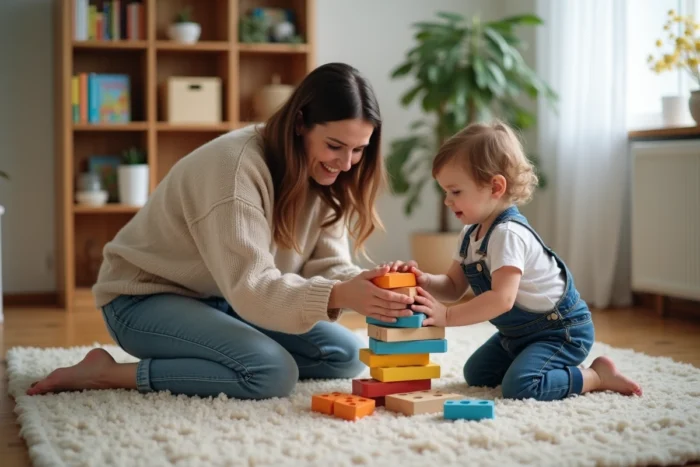
A family ritual refers to a recurring, predictable moment in which each household member participates. Its function is twofold: it creates a stable temporal reference for children and generates a space for connection for adults. Evening meals without screens, bedtime reading, or Sunday morning walks fall into this category.
Not all rituals are equal. Those that endure over time share three characteristics:
- They are short (between fifteen and thirty minutes), making them compatible with a busy schedule.
- They require no heavy preparation: no specific materials, no complex planning.
- They allow for improvisation. A ritual that is too rigid becomes a chore as soon as fatigue sets in.
The classic trap is to multiply rituals to the point of turning every evening into a timed program. One or two well-established rituals are enough to structure the family week. It’s better to have a single protected moment that everyone looks forward to than a succession of imposed activities.
Adapting Rituals to Children’s Ages
A ritual designed for a three-year-old no longer works for an eight-year-old. The board game on Wednesday evening holds as long as the rules remain stimulating for everyone. When the age gap between children widens, the ritual must evolve: shifting from a directed activity to a moment of free conversation, for example, helps maintain everyone’s engagement.
Managing Family Tensions: Setting a Framework Before the Crisis
Most recurring family conflicts arise from misunderstandings about expectations. Who does what, when, and according to which rules: without an explicit framework, each household member operates with their own assumptions, often incompatible with those of others.
A family framework is built calmly, not in the heat of a dispute. Practically, this means establishing a few simple rules during a calm moment: division of household tasks, screen time limits, organization of homework. These rules benefit from being formulated with the children as soon as they are old enough to understand, which strengthens their adherence.

Differentiating Normal Tension from Warning Signals
Daily frictions between siblings, a teenager slamming their door, a parent exasperated after a busy day: all this falls within the normal functioning of a household. Tension becomes a warning signal when it recurs on the same issue without ever finding resolution, or when a family member withdraws from interactions for an extended period.
In these cases, seeking external support is not an admission of failure. Parenting support measures have strengthened in recent years. The Senate report on child protection emphasizes the need for increased home interventions and alternative measures, providing more emotional stability for the child in a family environment.
Family Benefits and Administrative Procedures: What Changes in 2026
Family balance also depends on the financial security of the household. However, family benefits are often underutilized due to lack of information. Family allowances depend on the number of children, resources, and the age of the children. Any change in family situation (birth, separation, relocation) must be reported quickly to avoid delays in payments.
In terms of housing, a bill submitted on April 14, 2026, proposes a family PTZ aimed at helping households with children purchase a larger home or finance expansion work. This measure would also concern already established homeowners, distinguishing it from the classic PTZ reserved for first-time buyers.
- Check eligibility for CAF benefits each year after a change in income or household composition.
- For homeschooling, submit the authorization request to the DSDEN before May 31 each year, as conditions have tightened since 2022.
- Follow the developments of the family PTZ, whose final terms have not yet been established.
These measures do not replace the attention given to relationships within the household, but they lift material constraints that directly weigh on the family climate. A home that is too small, parental leave that is too short, or unreceived aid generates a silent pressure that ultimately affects every family member.
Building a fulfilling family life daily involves acting on two simultaneous fronts: relational habits (rituals, framework, tension management) and material conditions (aid, housing, leave). Neglecting one weakens the other, regardless of the investment made.