On Monday evening, past eight o’clock, a cluttered workspace and nothing ready. We open the fridge, grab what’s lying around, and within minutes we want a decent dish without turning the kitchen into a battlefield. It’s this precise situation, repeated five times a week, that decides whether we cook at home or order takeout.
The major dietary principles don’t change anything when the real barrier is the lack of time, space, and clean dishes.
Cooking at home in ten minutes without batch cooking
Batch cooking assumes a free slot on Sunday, a series of containers, and a spacious refrigerator. When you have none of that, you need to think differently: not preparing in advance, but reducing the number of actions at cooking time.
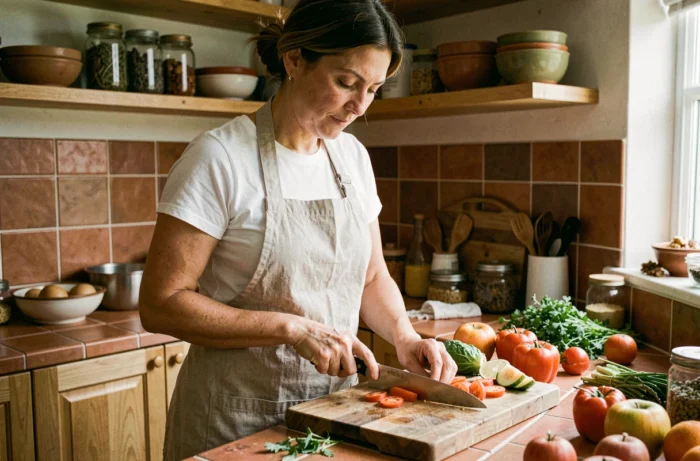
A quick meal relies on three elements assembled without a formal recipe: a quickly cooked base (pasta, couscous, rice), a vegetable that doesn’t require peeling (cherry tomatoes, salad, cucumber, sliced zucchini cooked in a pan), and an express protein (egg, canned tuna, leftover chicken). By combining these three pillars, you get a balanced dish in under ten minutes, using just one pan or pot.
You can also find Myn Idee’s tips on Cookinette that detail this logic of quick assembly applied to daily life.
For individual portions of rice, a cup with an improvised lid in the microwave is sufficient. You measure the water directly in the cup, cover it, and a few minutes later it’s ready. One cup, zero pots to wash. This kind of shortcut changes the game when the sink is already full.
Breaking down tasks by action, not by recipe
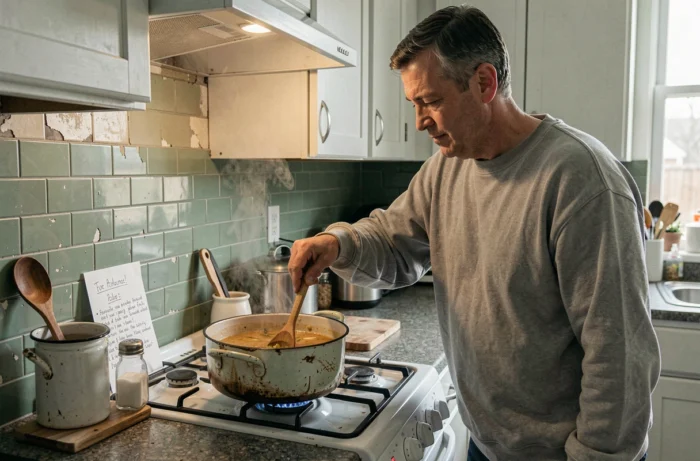
When preparing two different dishes in a week, the classic reflex is to follow each recipe from start to finish. You take out the cutting board, chop the onions, put things away, then start again for the second dish. The time lost is enormous.
The practical approach is the opposite: group identical actions into one time slot. You peel all the vegetables at once, start all the cooking in parallel, and season at the end. This breakdown by type of task (cutting, cooking, seasoning) rather than by recipe significantly reduces the time spent standing.
Specifically, if you plan to have zucchini for tonight and soup for tomorrow, you slice everything at the same time on the same board. Half goes into the pan, the other half into a pot of water. Two meals progress simultaneously with just one cleanup of the board and knife.
Storage and hygiene in the refrigerator: actions that prevent waste
Cooking at home is pointless if leftovers end up in the trash three days later. Preservation starts with a well-organized refrigerator kept at the right temperature.
- Place the most fragile products (raw meat, fish) in the coldest zone, usually the bottom section, to limit bacterial growth.
- Store fruits and vegetables in the designated drawer, with a pinch of baking soda at the bottom to absorb odors and moisture. Replace it regularly to maintain its effectiveness.
- Transfer leftovers into airtight glass containers as soon as they have cooled, labeling them with the date on a piece of tape. An unidentified leftover almost always ends up being thrown away.
A clean and well-organized refrigerator reduces waste just as much as meal planning does. When you can clearly see what it contains, you cook with what is available instead of buying duplicates.
Express legumes: quick soaking in hot water
Lentils, chickpeas, and dried beans are among the most economical and nutritious foods for home cooking. The classic problem is the overnight soaking that requires planning the day before.
A little-known technique in mainstream guides is to soak legumes in water at 60 °C. The soaking time then goes from about twelve hours to two or three hours. You heat the water, pour it over the legumes in a bowl, cover it, and let it sit. When you get home from work, they are ready to cook.
This shortcut allows you to integrate legumes into a weekly rotation without heavy planning. A chickpea curry or a warm lentil salad can then be prepared in about twenty minutes with seasonal vegetables.
Small kitchen and minimal dishes: adapting equipment to reality
The utensil recommendations found everywhere (mandoline, food processor, complete set of pots) assume a kitchen equipped with storage. In a studio or small apartment, you operate with the bare minimum.
Three utensils cover most daily needs: a medium-sized pan, a pot, and a good knife. The rest is comfort, not a necessity. A well-sharpened knife is better than five gadgets that clutter a drawer.
To limit the dishes, cook and serve in the same container when possible. A stir-fry of vegetables can be eaten directly from the pan placed on a trivet. A garnished rice dish can be prepared and served in the same pot. Feedback on this point varies according to individual habits, but the time saved on cleaning is real.
The challenge of home cooking daily is not to reproduce elaborate recipes. It’s to create a routine of simple actions that lasts over time, even when motivation is lacking. A basic homemade meal prepared in ten minutes with three fresh ingredients remains nutritionally superior to most prepared dishes and costs a fraction of the price.