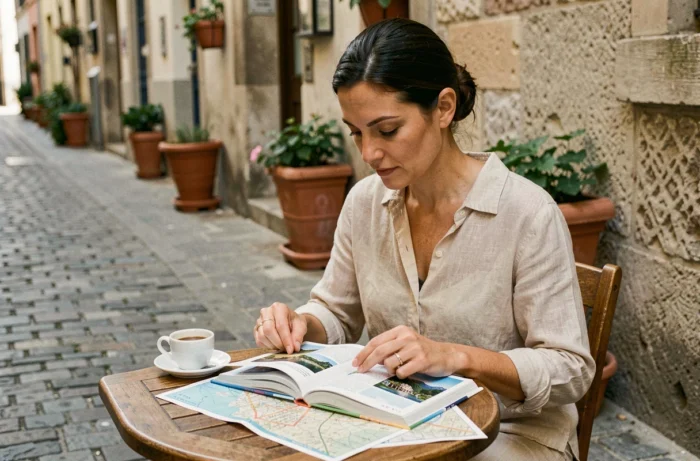
A tourist guide refers to two distinct things: a book (paper or digital) that compiles practical information about a destination, and a person who accompanies a group on-site. This distinction radically changes the selection criteria. Choosing the right travel guide, regardless of its format, means identifying what you specifically expect before, during, and after your stay.
Guide-person, guide-book, digital guide: three different professions
The confusion between these three categories explains many disappointments. A professional tourist guide (the person) operates within a specific scope, with a knowledge of the terrain that neither a book nor an app can replace. Their role includes historical storytelling, adapting the pace to the group, and managing unforeseen events.
A paper guide, on the other hand, functions as a planning and on-site consultation tool. It structures information by destination, proposes typical itineraries, and lists addresses. The digital guide (app, interactive PDF) adds geolocation and real-time updates, but loses the advantage of functioning without a connection in some cases.
To choose between these formats, the initial question remains the same: do you need human support on-site, or a preparation and self-exploration tool? The answer guides everything else.
As detailed in the advice from 123 Voyages, each type of guide serves a specific purpose, and combining them often remains the best strategy.
Selection criteria for a paper or digital travel guide

The publication date is the first filter and the most overlooked. A paper guide published more than three years ago likely contains closed addresses, outdated prices, and modified transport lines. Always check the year of publication, not just the year of the first edition.
The second criterion concerns the balance between practical content and cultural content. Some publishers prioritize historical context and in-depth analysis (Lonely Planet, Michelin Green Guide). Others focus on good deals, price ranges, and daily logistics (Le Routard). None is better in absolute terms, but one will align more closely with your travel style.
The third filter is geographical granularity. A guide covering an entire country is suitable for initial scouting or a quick trip. For an extended stay in a specific region, a regional guide or city guide will provide much denser information.
- Check the date of the last update (not just the date of the first edition) to avoid outdated information.
- Compare the portion dedicated to practical information (transport, accommodations, budgets) with that dedicated to cultural or historical context.
- Prefer a guide whose geographical scale matches the duration and actual scope of your stay.
Selecting a professional tourist guide on-site
The choice of a human companion relies on criteria that booking platforms do not always highlight. The first is certification or official approval. Local tourist offices sometimes publish lists of certified guides or approved operators, which provide a more solid reliability signal than online reviews alone.
Thematic specialization is as important as geographical knowledge. A guide specialized in architectural heritage will not approach a city like a guide focused on street art or gastronomy. Identifying your priority allows for quick filtering.

A rarely discussed point: the customization of the itinerary from the first contact. The best guides offer to adapt the itinerary to your physical condition, interests, or dietary restrictions. If this flexibility is not mentioned upfront, ask the question before booking. A guide who refuses any adjustments indicates a standardized service, not a tailored experience.
On booking platforms, trust signals have refined over the years. Verification badges, flexible cancellation policies, instant confirmation: these technical elements complement the reading of reviews, which can sometimes be biased or outdated.
Combining formats to cover every phase of the trip
Preparation, on-site experience, and return do not require the same type of guide. In advance, a paper or digital guide allows for building a coherent itinerary, estimating a realistic budget, and identifying logistical constraints (visas, vaccinations, seasons).
On-site, a guide-person provides a layer of living and contextual information that no book can replicate. For visits to heritage sites or protected natural areas, human accompaniment often remains the only way to access certain spaces.
- Use a paper or digital guide for the planning phase and daily logistical references.
- Book a local professional guide for visits that gain depth with live commentary.
- Consult the official websites of tourist offices to verify credentials and find listed providers.
Upon return, the notes accumulated in an annotated paper guide serve as an informal travel journal, useful for recommending addresses or preparing for a future stay in the same area.
The perfect travel guide does not exist as a single object. The combination of an up-to-date written resource, a qualified local guide, and verification through official institutions covers the vast majority of needs, regardless of the type of destination.