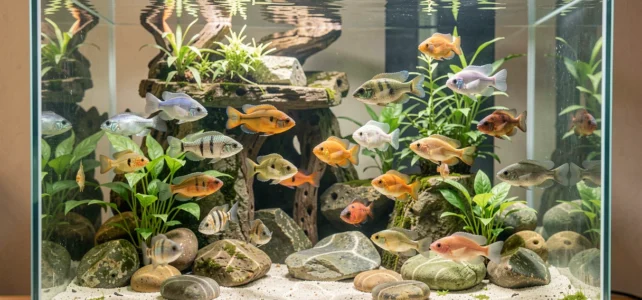
When setting up a first tank of African cichlids and two males relentlessly chase each other from the very first week, the question is no longer whether these fish are territorial. It is about understanding how to transform this aggression into a viable balance. Cichlids form a family that includes several hundred species distributed between Africa and America, with radically different water, volume, and behavioral requirements from one group to another.
Controlled overpopulation in a Malawi tank: the technique that changes everything
Classic guides repeat that cichlids are territorial. We know that. What is often missing is the operational answer. In a Malawi-type tank populated with Mbuna, the most documented strategy by experienced aquarists is to maintain a dense group to distribute aggression among all individuals.
The principle is simple: when a dominant male cannot fixate on a single rival, the pressure dilutes. We are talking about installing about fifteen Mbuna or more in a tank of approximately 200 liters, provided that filtration is reinforced and significant weekly water changes are ensured. Without this rigor on water quality, overpopulation becomes a health trap.
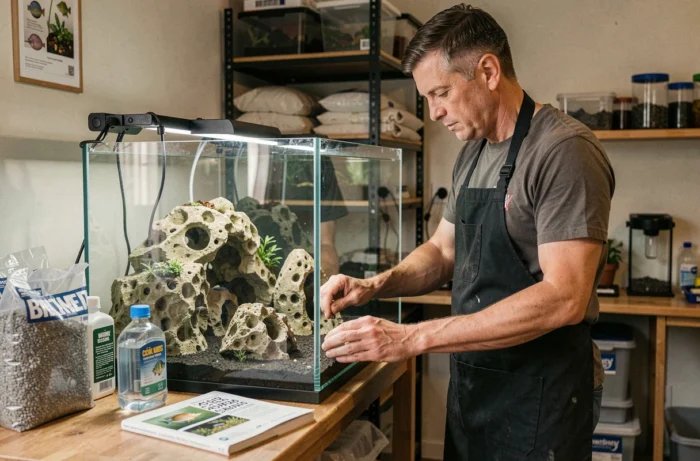
This approach also assumes a layout designed to break sight lines: stacks of rocks forming caves, sand as substrate, very few plants. Each fish must be able to take refuge out of the dominant’s line of sight.
If we neglect the number of hiding spots, we find an individual harassed in a corner, fins in tatters. Regular feedback on this subject is published on platforms like cichlidae.be, where exchanges among French-speaking keepers help refine these ratios according to species.
African or American cichlids: aquariums that have nothing in common
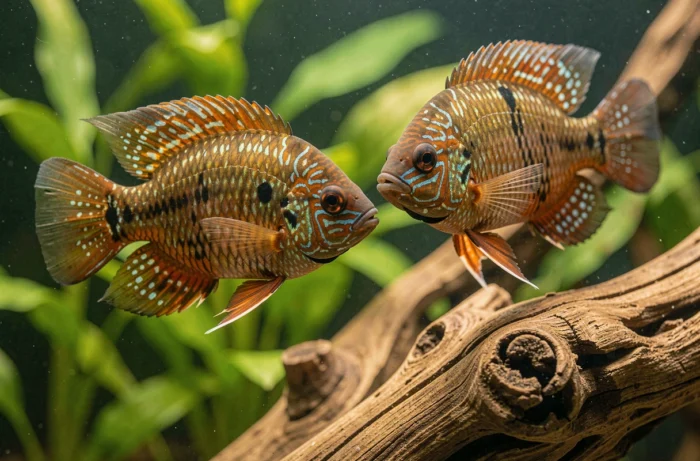
Grouping all cichlids under the same label ignores that the water parameters between a Malawi tank and an Amazonian tank are opposite. Species from Lake Malawi (Mbuna, Haplochromis, Aulonocara) live in hard, alkaline water. South American species (angelfish, discus, ramirezi) require soft, acidic water.
In practice, this means that these two groups are never mixed in the same tank. The layout also differs radically:
- Malawi tank: stacked rocks, coral sand or fine sand, little or no vegetation, moderate lighting
- Amazonian tank: roots, dense plants (Echinodorus, Anubias), dark substrate, light filtered by floating vegetation
- Tanganyika tank: snail shells for small species (Neolamprologus), flat rocks, fine sand, hard and alkaline water like Malawi but with often smaller species and different territorial behaviors
The recent trend towards high-end Malawi biotope aquariums is pushing many new aquarists towards tanks of 300 liters and more. This is a good reflex, as the volume buffers water quality and offers more retreat areas.
Minimum volume according to cichlid type
For a pair of ramirezi, a tank of 80 liters may be sufficient. For a group of Mbuna, it is rare to go below 200 liters without risking chronic aggression problems. Discus, on the other hand, require a generous volume and significant water height. The tank volume directly conditions the long-term survival rate.
Managing aggression on a daily basis: warning signals and adjustments
The aggression of cichlids is not resolved once and for all at the time of filling the tank. It evolves with sexual maturity, breeding periods, and changes in hierarchy. When a male begins to obsessively dig in the substrate or blocks access to food for others, it is a signal.
Possible adjustments are concrete:
- Reorganize the layout (move the rocks) to break established territories and force a redistribution
- Temporarily remove the dominant male to a separate tank for a few days, then reintroduce him: he loses his status and must renegotiate his place
- Add individuals to dilute the pressure, ensuring that filtration keeps up
- Monitor mouthbrooding females (common among Mbuna): a female holding her fry in her mouth does not eat and can weaken if harassed
Feedback varies on this point, but some keepers report that angelfish can also become aggressive during spawning periods, even in a planted community tank. The size of the group and the layout configuration remain the two main levers.
Filtration and maintenance: the non-negotiable foundation of a cichlid tank
A densely populated tank of African cichlids produces a high organic load. These fish eat a lot, dig in the substrate, and generate waste in proportion. Filtration must circulate at least three to four times the tank volume per hour.
Weekly water changes are not optional. We are talking about a significant renewal each week, with siphoning of the bottom to remove accumulated waste between the rocks. Without this rhythm, nitrates rise and cichlids develop chronic pathologies (lateral line erosion, color loss, bacterial infections).
Species-appropriate feeding
Mbuna are primarily herbivorous: they graze on algae on the rocks in their natural habitat. Food that is too rich in animal proteins causes bloating, sometimes fatal. American species like discus, on the other hand, require a higher protein intake. Adapting food to the natural diet of the species avoids most common digestive problems.
Keeping cichlids long-term requires more rigor than a classic community tank of guppies or neon tetras. Volume, filtration, layout, population density, and feeding form an inseparable whole. Modifying a single parameter without adjusting the others creates an imbalance that pays off in a few weeks.