
A math exercise asks to convert 42 kilometers into miles, and the expected result is not a round number. The conversion between these two units of distance relies on a single factor, but one must know which way to apply it and how to avoid common calculation errors.
The km-mile conversion factor and why it isn’t round
The mile is the unit of distance used in English-speaking countries, notably in the United States and the United Kingdom. The kilometer belongs to the metric system, adopted by the vast majority of other countries.
1 mile is exactly 1.60934 kilometers. This number is not arbitrary: it stems from the historical definition of the mile, established long before the invention of the metric system.
In practice, for middle or high school math homework, it is often rounded to 1.609 or even 1.6. Your statement sometimes specifies the value to use. Read it carefully before calculating: a different rounding changes the final result, and thus the grade.
To delve deeper into the step-by-step method, the km to miles conversion page on Mega REF details each step with examples suitable for students.
Step-by-step km to miles conversion formula
You have a distance in kilometers and you are looking for the equivalent in miles. The formula is one line long:
miles = kilometers divided by 1.60934
Let’s take a concrete example. The exercise asks: “Convert 10 km to miles.” You divide 10 by 1.60934. The result is approximately 6.21 miles.
With a rounding to 1.6, the calculation gives 10 / 1.6 = 6.25 miles. The difference seems minimal, but over long distances, it grows. Keep the most precise value possible, unless instructed otherwise.

Convert in the other direction: miles to kilometers
The formula simply reverses:
kilometers = miles multiplied by 1.60934
If the exercise gives 5 miles, you multiply 5 by 1.60934. Result: approximately 8.05 km. The multiplication replaces the division; that’s the only change.
Common trap in assignments
Many students confuse the two operations. They multiply when they should divide, or vice versa. A tip to never make a mistake: the mile is larger than the kilometer. Therefore, a journey expressed in miles always results in a smaller number than in kilometers.
Are you converting km to miles? The result should be smaller than the starting number. If not, you multiplied instead of dividing.
Quick method to check a result without a calculator
During a test, the calculator is not always allowed. Here’s a mental estimation method that works well:
- Divide the number of kilometers by 8, then multiply by 5. For example, 24 km: 24 / 8 = 3, then 3 x 5 = 15 miles. The exact value is 14.91 miles, the difference remains very small.
- For the reverse direction (miles to km), reverse: divide the miles by 5, then multiply by 8. With 15 miles: 15 / 5 = 3, then 3 x 8 = 24 km.
- This method relies on the ratio 5/8, which equals 0.625. The actual factor (1/1.60934) is approximately 0.6214. The precision is sufficient to verify an order of magnitude.
This check takes a few seconds and helps catch a gross error before submitting your work.
Typical corrected exercise: km-miles conversion with speed units
Km-mile conversions are not limited to distances. In physics and math, they also appear in speed exercises.
Statement: “A car is traveling at 120 km/h. What is its speed in miles per hour?”
The approach is the same. We only convert the distance, not the time. 120 divided by 1.60934 gives approximately 74.56 mph (miles per hour).
Have you noticed that speed limit signs in the United States display lower numbers than in France? This is exactly why: the mile is longer than the kilometer, so the numerical value of speed decreases.
Presenting the calculation to gain points
Markers appreciate clear writing. Here’s how to structure your answer:
- Write the formula used before replacing it with numerical values
- Indicate the value of the conversion factor retained (1.609 or 1.60934 according to the statement)
- Present the intermediate calculation, then give the rounded result with the unit
- Check for consistency: is the result in miles indeed less than the number of km?
Always write the unit next to the final result. A number without a unit in measurement conversion is almost always a lost point.
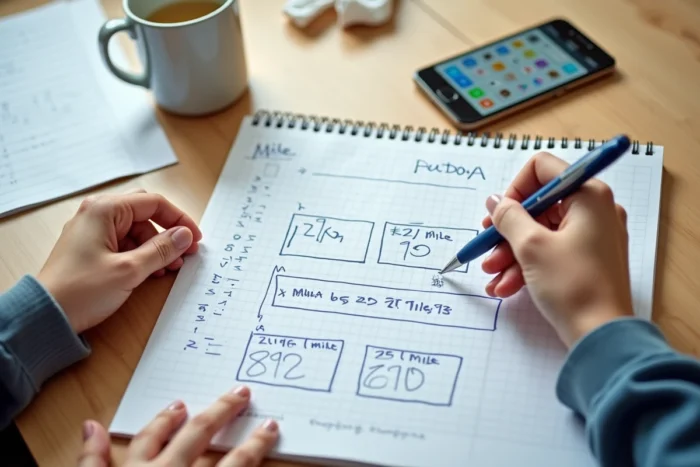
Km-miles conversion: errors that cost points in exams
Beyond the multiplication/division confusion, other errors frequently appear in assignments.
The first concerns premature rounding. If you round at each intermediate step, small inaccuracies accumulate, and the final result strays from the expected value. Keep the decimals until the final result, then round according to the instructions (often to the hundredth).
The second error is forgetting the conversion when the exercise mixes data in kilometers and miles. Before any calculation, convert all distances to the same unit. Choose the one requested by the statement.
The third touches on exercises involving composite quantities (speed, flow). Some students convert the distance but forget to check that the time remains in the correct unit. For a conversion from km/h to mph, only the distance changes. For a conversion from km/h to miles per minute, you also need to divide by 60.
The kilometers-miles conversion relies on a single value to remember and two possible operations. The factor 1.60934 (or its rounding to 1.6) is sufficient to handle all school exercises on this topic. Practice on three or four varied examples, and the reflex will become automatic.