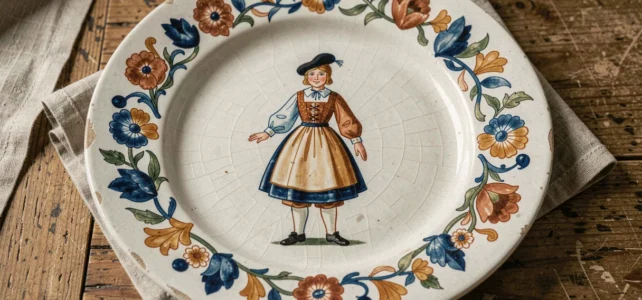
Every Breton flea market sees plates stamped “Quimper” without their owners really knowing what they hold in their hands. Identifying an authentic Henriot Quimper plate and determining its manufacturing period relies on a few precise material clues, mainly concentrated on the back of the piece. The difficulty lies in the fact that several Quimper factories coexisted for decades, with signatures that evolved over time due to mergers and acquisitions.
Chronology of marks on the back: the key to dating Henriot pottery
The chronological sequence of signatures is what allows for narrowing down a timeframe without consulting a complete catalog.
Two distinct historical lines produced pottery in Quimper: HB (Hubaudière-Bousquet) and Henriot. They only merged in the 20th century. This merger directly affects what is read on the back of a plate.
- A piece bearing only “HB Quimper” refers to the Hubaudière-Bousquet production, before or shortly after the merger with Henriot.
- The mention “Henriot Quimper” alone corresponds to a phase where the Henriot brand is highlighted as a separate entity, distinct from HB.
- Pieces marked “HB-Henriot” or “HR” (after 1968) indicate the post-merger period, when the two houses are grouped under a single commercial identity.
- “Henriot Quimper France,” with the mention of the country, appears on pieces intended for export or on more recent productions.
This progression (HB → HB-Henriot → Henriot Quimper France) constitutes the first filter for dating. A plate that bears none of these mentions, but only “Quimper” without further specification, poses a problem: it may come from another Quimper pottery or be a modern imitation with no connection to the Henriot house.
To identify a Henriot Quimper plate more precisely, one must cross-reference the signature with other clues from the back: traces of placement in the kiln, mold numbers, or painter’s initials.
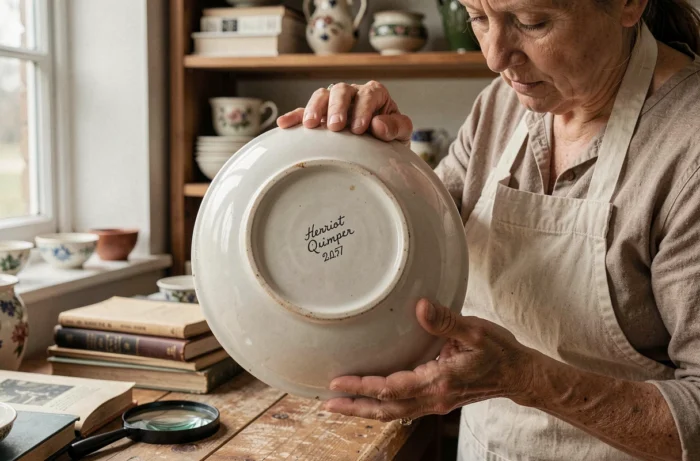
Back of the Henriot plate: traces of manufacturing and hidden clues
The top of a plate catches the eye, but it’s the underside that reveals the evidence. Several material elements coexist there, and their combination helps refine the dating.
Marks of supports and traces of firing
Supports are small ceramic props used to stack pieces in the kiln. They leave characteristic marks, often three small dots in a triangle, on the back or edge of the plate. Irregular support marks indicate an old artisanal production. On recent pieces, these marks are absent or much more discreet due to modern firing techniques.
Mold numbers and painter’s initials
A number engraved or painted on the back generally corresponds to a mold model listed by the manufacturer. The initials identify the painter who decorated the piece. The presence of handwritten initials (and not stamped) reinforces the hypothesis of an old piece painted by hand. The available data does not always allow for confidently attributing an initial to a specific artist without specialized documentation.
Quality of the glaze and color of the body
When flipping the plate, the unglazed area (the foot or placement ring) reveals the color of the raw body. A porous, slightly grainy body of cream color is typical of traditional stanniferous pottery. A very white and smooth body points towards later industrial production or another type of ceramic.
Hand-painted decoration or reproduction: spotting the difference on a Quimper plate
The decoration is the second pillar of authentication, after the back. Henriot factories employed painters who reproduced Breton motifs according to precise standards, but with slight variations inherent to human touch.
An authentic hand-painted decoration shows subtle irregularities in the thickness of the lines, the arrangement of colors, and the outline of characters. Modern reproductions, whether screen-printed or transferred, exhibit mechanical uniformity: perfectly identical lines from one piece to another, uniform colors without variation in density.
The most common motifs (little Breton, little Breton girl, “touch” decoration) have been produced over decades. The motif alone is therefore not sufficient to date a piece. However, the color palette used and the style of the border (geometric frieze, floral garland, simple line) evolve over time and can provide additional clues.
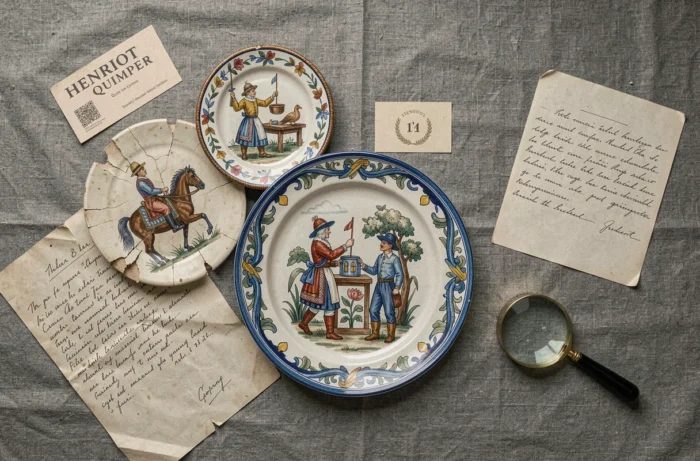
Limits of authentication without specialized expertise
Cross-referencing the mark, traces of manufacturing, and the style of decoration allows for placing a plate within a reasonable historical range. This approach has its limits.
Some old pieces have been restored with modern materials, which obscures surface clues. Others bear signatures partially erased by wear, making reading uncertain. Field returns vary on the reliability of the body color as the sole criterion, because the composition of the clay may have varied according to the factory’s supplies.
The official Henriot-Quimper website recommends contacting specialized auctioneers in Quimper pottery for any request for formal expertise. The factory itself indicates that it is not authorized to authenticate old pieces or estimate their value.
The plate you turn over at a garage sale tells part of its story through its marks, defects, and glaze. The chronology of signatures guides dating more quickly than examining the decoration or shape. To go further, good lighting, patience, and sometimes a specialized auctioneer will make the difference.