
Buying or selling a property in Belgium is not just about finding the right price. Registration fees vary by region, market dynamics differ significantly between the coast, Brussels, and Wallonia, and the profile of buyers is evolving: each real estate project relies on measurable parameters. This article compares recent data to identify where the most significant discrepancies lie.
Registration fees in Belgium: regional comparison
| Region | Registration fees (standard rate) | Reduced rate (primary residence) |
|---|---|---|
| Flanders | 12 % | 2 % (own residence, under conditions) |
| Wallonia | 12.5 % | 3 % (own and unique residence, from January 2025) |
| Brussels | 12.5 % | Deduction on the first tranche |
This table summarizes a gap that directly impacts the acquisition budget. In Flanders, the reduced rate of 2 % for an own residence generates considerable savings compared to the other two regions. For a property of comparable value, the difference in fees can represent several tens of thousands of euros.
Wallonia and Brussels apply a standard rate of 12.5 %. Relief measures exist in both cases, but the access conditions differ. The Walloon reduced rate of 3 % is aimed at the own and unique residence. In Brussels, a deduction applies to the first tranche of the price.
Checking eligibility with a notary before signing a compromise remains the most reliable approach to avoid budget errors. The listings published on immo-trade.be allow for cross-referencing available properties with their regional location, facilitating this initial estimate of fees.
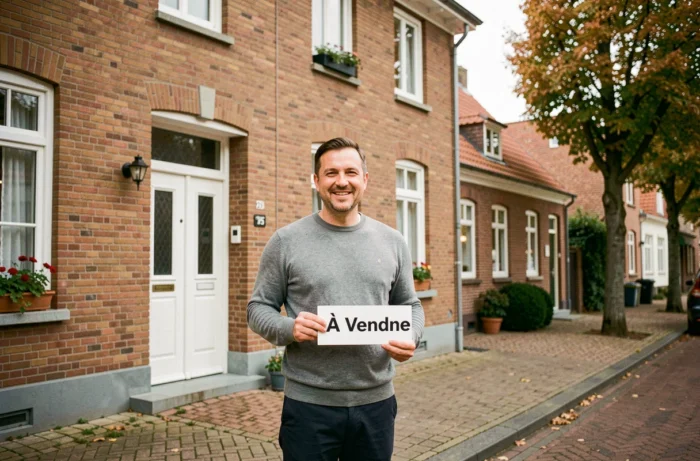
Real estate prices in Belgium: disparities between the Belgian coast, Brussels, and Wallonia
The average price of houses in Belgium reached 346,648 euros in the first half of 2025, an increase of 5.1 %. This national average aggregates market segments that evolve according to very different logics.
The Belgian coast, a unique market
The coast has regained marked dynamism. According to Fednot data, sales at the coast increased by about 8 % in the first half of 2026 compared to the same period in 2025. The median price of apartments there has started to rise again after a decline the previous year.
The profile of buyers is very targeted: average age around 51 years, majority over 50 years, more than 80 % of buyers are Flemish. The share of foreign buyers and young first-time buyers remains low. For a seller, this demographic data directs the communication strategy towards a heritage audience.
Brussels and Wallonia, two distinct logics
In Brussels, rental demand remains strong due to its status as a European capital, the presence of expatriates, and students. High prices mechanically limit returns for investors.
In Wallonia, significantly lower acquisition prices attract a buyer profile often oriented towards rental investment. The province of Luxembourg illustrates this contrast: after a period of high activity, the Ardennes market is experiencing a phase of price stabilization, which may represent an entry point for some buyers.
Selling a property in Belgium: data on the use of professionals
Nearly eight out of ten sellers enlist a real estate professional to sell their property, according to figures published by Immoweb. This rate reflects the administrative complexity of a transaction in Belgium.
A seller who sells without assistance manages all documentary obligations alone. The omission of a single certificate can delay the signing of the authentic deed by several weeks.
- The EPC certificate (Energy Performance Certificate) must be available from the moment of sale, not just at the time of the compromise
- The electrical installation report is required for any sale of a residential property
- In Flanders, a soil certificate issued by OVAM is required before signing the compromise
- Urban planning information must be requested from the municipality and attached to the file
Gathering these documents before publishing the listing shortens the time between the purchase offer and the signing of the deed.

Real estate financing: borrowing behaviors in 2026
The rise in borrowing rates observed in recent years has changed the behaviors of Belgian buyers. Searches are taking longer, negotiations on price are becoming tougher, and the overall budget (price, fees, renovations) is subject to tighter calculations.
This change in behavior favors properties in good condition, ready to move into. Properties requiring significant renovation work sell more slowly, unless the listed price already includes the cost of the anticipated work.
For a seller, setting a realistic price from the outset reduces the risk of stagnation. A property overvalued by a few percent compared to the local market stays online longer and often suffers a larger discount during a late correction.
The Belgian market remains active, with an overall increase in transactions observed in the first half of 2026. Demand is concentrated on properties correctly priced and compliant from an administrative standpoint. Whether the project involves a purchase at the coast, a rental investment in Wallonia, or a sale in Brussels, documentary preparation and analysis of regional discrepancies condition the final financial outcome.