
We just bought a used car, the seller hands us the crossed-out registration certificate, and the question arises: what documents do we need to gather so that the application goes through the first time? A missing or expired document is enough to block the request for several weeks. It’s better to know each required piece, including those that change depending on the situation, before starting the process on the ANTS website.
Transfer code and certificate of non-pledge: the documents we forget first
Most application refusals do not come from forgetting an identity document. They come from two lesser-known documents: the transfer code and the certificate of administrative situation, often referred to as the certificate of non-pledge.
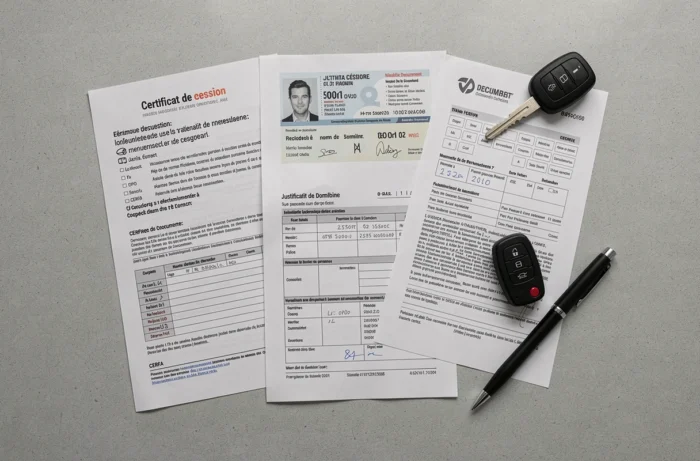
The transfer code is generated when the previous owner declares the sale online on the ANTS website. Without this code, the registration request cannot be completed. If the seller has not finalized their declaration, we find ourselves stuck. In this case, we either need to prompt them to finish the procedure or go through an authorized professional who can handle the file based on the crossed-out registration certificate and the paper transfer certificate (CERFA 15776).
The certificate of administrative situation proves that the vehicle is not subject to any pledge or opposition. It can be obtained for free from the Ministry of the Interior’s website. It is valid for a limited time, so it’s best to download it at the last moment, just before compiling the file.
The complete list of documents required for a registration certificate varies depending on whether you are buying a new or used vehicle, but these two documents are the ones that generate the most blocks for used cars.

Proof of residence for registration certificate: the freshness rule that is tightening
It is often thought that a current year electricity bill will suffice. In practice, the administration requires a proof of residence less than six months old, and checks on this point have intensified in recent years.
The accepted documents remain classic:
- Energy bill (electricity, gas), water, or landline phone bill dated less than six months
- Tax notice or non-tax notice for the current year or the previous year
- Rent receipt issued by a landlord or social organization, not handwritten
- Home insurance certificate mentioning the address of the residence
If you are staying with a third party, you must add a handwritten accommodation certificate, a copy of the host’s ID, and a proof of residence in their name.
Technical inspection and insurance certificate: two validity traps
For a used vehicle over four years old, the technical inspection must be dated less than six months at the time of filing the application. An inspection done seven months earlier, even if favorable, will be refused. Check the date before starting the process, not after.
The insurance certificate must cover the vehicle on the day of the registration request. A temporary insurance memo is sufficient if the final card has not yet been issued, provided that the registration number or policy number is included.
The case of the imported vehicle
A vehicle purchased abroad requires a European conformity certificate (COC) issued by the manufacturer. This document proves that the model meets the homologation standards in force in France. Without a COC, one must go through an isolated reception with the DREAL, a longer and more expensive procedure. Feedback on the timeframes for obtaining the COC varies by brand, but it is prudent to allow several weeks.
Archiving documents by authorized professionals: what has changed in 2026
When you entrust your request to a registration certificate provider (garage, online platform), you send your proofs via a CERFA 15757 mandate. Since an order published in the Official Journal on July 26, 2026, the rules for retaining these documents have been significantly tightened.
Professionals authorized in the Vehicle Registration System (SIV) must now archive each document in a digital safe compliant with the NF Z 42-020 standard for five years. The state can access it in case of a check. Authorization agreements are no longer automatically renewed: each renewal requires a re-examination of the professional.
In practice, this means that our identity documents, proof of residence, and mandates are tracked and stored securely. This is an additional guarantee against registration fraud, but also a point to keep in mind if you are sending sensitive documents to a provider whose authorization you have not verified.
Check that a provider is actually authorized
Before entrusting your file, you can check a professional’s authorization directly on the ANTS website. An unauthorized provider cannot legally register a registration request. The verification takes a few minutes and prevents you from losing your documents or paying for a service that will not be completed.
Summary of the registration application according to the type of vehicle
| Document of the file | New vehicle | Used vehicle |
|---|---|---|
| Application for registration certificate (CERFA 13750) | Yes | Yes |
| Valid identity document | Yes | Yes |
| Proof of residence less than 6 months old | Yes | Yes |
| Insurance certificate | Yes | Yes |
| Driving license (corresponding category) | Yes | Yes |
| Transfer certificate (CERFA 15776) and transfer code | No | Yes |
| Crossed-out registration certificate from the previous owner | No | Yes |
| Certificate of administrative situation (non-pledge) | No | Yes |
| Technical inspection less than 6 months old | No | Yes (if vehicle over 4 years old) |
| Conformity certificate (COC) or DREAL reception | Provided by the dealer | If imported vehicle |
The legal deadline to submit the application after purchase remains set at one month. Beyond that, you risk a fixed fine. A complete file from the start, with each document up to date and in the correct format, remains the only reliable way to meet this deadline without follow-ups or rejections.