
The ready-to-wear market is full of pieces that take visual cues from major fashion houses. Between stylistic homage and pure imitation, the line remains blurred for most buyers. Spotting a garment inspired by top designers requires the ability to read clues that marketing seeks to obscure: fabric construction, interior finishes, consistency of details.
What the textile material reveals before cutting
The cut catches the eye, but it is the material that betrays the level of execution. A garment inspired by a haute couture piece focuses first on the silhouette, rarely on the quality of the textile. This is where the gap widens.
A high-end fabric is distinguished by its touch and drape. The hand (the technical term for the tactile sensation of a fabric) of a silk crepe or Italian wool drape is nothing like that of a textured polyester, even if it looks visually similar. A premium fabric retains its shape after wrinkling: squeeze it in your hand for a few seconds, then release. A dense, well-woven fabric returns to its shape, while a low-quality fabric retains the creases.
Also look at the selvage of the fabric (the finished edge along the length of the roll). On a garment made from a couture fabric or from end-of-stock materials, the selvage sometimes bears the name of the manufacturer or the original house. On a “inspired” piece produced in large quantities, the selvage is anonymous or non-existent.
To delve deeper into these visual and tactile criteria, Magmoiselle’s fashion tips detail several concrete markers applicable both in-store and online.
Interior finishes and construction: the clues that marketing doesn’t show
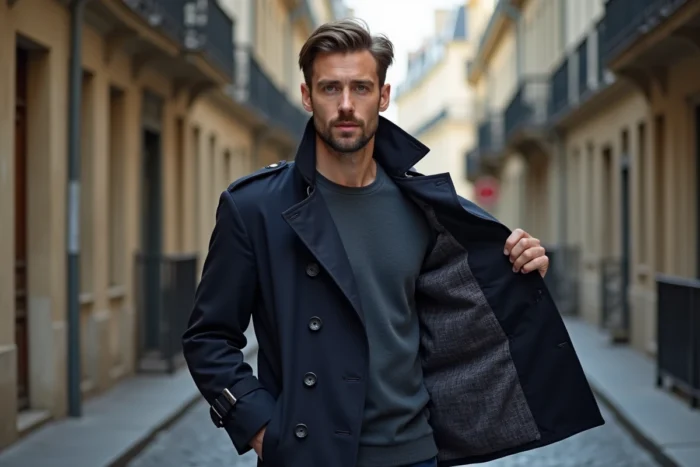
Turning a garment inside out is the most effective gesture to judge its real relationship with a designer piece. Brands that invest in construction pay attention to the inside as much as the outside. Brands that copy a style focus on the visible side.
Seams and topstitching
On a quality couture piece, the interior seams are neatly overlocked, sometimes with bias or a “English seam” finish (the seam is folded over itself to hide the raw edge). On a quick imitation, the edges are simply overlocked in one pass, with threads sticking out.
- Regular topstitching, at a constant distance from the edge, indicates careful assembly. Irregular or wavy topstitching betrays accelerated production.
- Buttonholes should be clean, with no threads pulled. A piped buttonhole (slit and bordered with fabric) indicates a higher level of finish than a standard zigzag buttonhole.
- Full linings (not partial) on a jacket or coat inspired by a couture model are a strong marker: a full lining protects the structure and improves the drape.
Interfacing and hidden structure
Jackets inspired by Chanel blazers or Dior suits may replicate the silhouette, but the interfacing makes the difference. A fusible interfacing (heat-bonded) gives a rigid and flat appearance. A traditional sewn interfacing, more flexible, moves with the body’s motion. Pinch the lapel between two fingers and try to separate the layers: if the outer fabric clearly separates from the internal structure, the interfacing is glued.
Patterns, colors, and proportions: reading the codes of couture collections
Major houses develop signature patterns that return season after season. The oversized houndstooth, multicolored boucle tweed, the geometric monogram: these elements are quickly adopted by ready-to-wear, often within weeks of a fashion show.
An inspired pattern is recognized by its simplifications. Couture versions feature precise pattern matching at seams, even in pockets and collars. On a copy, the pattern is often misaligned at junctions, with stripes not aligning from one panel to another. This detail, visible from a distance, is the quickest to check in-store.
Proportions are another clue. Designers work on armholes, hem lengths, and shoulder widths calibrated to the millimeter for their target silhouette. Copies replicate the general shape but adjust the proportions for standardized production. The result: a shoulder that is too wide, a lapel that is too narrow, a waist placed too low. The consistency of proportions between collar, shoulder, and waist distinguishes mastered inspiration from hasty copying.

Labeling and traceability: what the regulations will change in 2026
The European regulatory framework is evolving. The Digital Services Act now imposes enhanced obligations on online platforms to remove counterfeit content. In practical terms, ads for garments that too closely copy a protected model can be reported and removed more quickly than before.
This legal pressure pushes “inspired” brands to distinguish themselves further from the originals, particularly through labeling. A honestly inspired garment displays its own brand, its exact textile composition, and its country of manufacture. The absence of this information, or vague mentions (“premium fabric,” “couture quality”), should raise alarms.
At the same time, the rise of circular fashion offers an interesting alternative. The second-hand market allows access to original designer pieces at reduced prices, often with better traceability than a new “inspired” piece sold on a marketplace.
- Check for the presence of a compliant composition label (percentage of fibers, country of origin).
- Look for the name of the manufacturer or design office: serious brands take pride in their identity.
- Compare the price with that of the original piece: a very large price gap (more than ten times) often indicates shortcuts on material and construction.
The distinction between legitimate inspiration and misleading copying relies on details that consumers can learn to read. Fabric, seams, proportions, labeling: these four levels of reading are sufficient to filter the majority of pieces in just a few minutes, whether in-store or on a screen.