
Most advice on home creativity focuses on personal routines or decoration. However, transforming your home into a place of daily innovation involves more concrete mechanisms related to air quality, acoustics, light, and each resident’s ability to modulate these parameters. The topic goes far beyond choosing a wall color or buying a notebook.
Air Quality and Indoor Temperature: The Invisible Barriers to Creativity
Content about creativity at home rarely mentions the physiological parameters of indoor space. Recent work in neuroarchitecture shows that high levels of CO₂ reduce cognitive performance, including the ability to solve problems in original ways. A poorly ventilated room, even if nicely decorated, can hinder creative thinking without its occupants being aware of it.
Temperature plays a comparable role. An interior that is too hot or too cold forces the body to maintain its thermal balance, at the expense of the attention available for imagining, designing, or experimenting. Before rethinking the design of a living room or office, it is more useful to check that the ventilation is working properly and that the temperature remains stable within a comfortable range.
Humidity and ambient noise complete this picture. A space where background noise is constant (traffic, appliances, reverberation on hard surfaces) continuously fatigues the brain. A few simple adjustments, such as thick curtains, a rug, or acoustic panels in a hallway, change the quality of attention throughout the home. For those looking for concrete layout ideas, you can access make-world.org and find resources on housing.

Neuroarchitecture and Control of Living Space
Neuroarchitecture studies the impact of built environments on brain function. One of its most concrete lessons for the home is that creativity increases when residents can control their environment. Being able to open or close a door, adjust light intensity, or acoustically isolate a work area gives the brain a sense of mastery that encourages intellectual risk-taking.
This observation has direct implications for interior design. A fixed living space, where the light is uniform and the furniture arrangement is unchangeable, does not encourage experimentation. In contrast, a room where the configuration can be modified (movable table, removable partition, adjustable blinds) provides a conducive environment for divergent thinking.
Natural Light and Contact with Nature
Natural lighting consistently appears in research on cognition and creativity. Studies in neuroarchitecture emphasize that daylight and views of natural elements reduce stress and improve concentration. An office facing a window overlooking a garden, even a small one, does not produce the same effect as a workstation oriented towards a wall.
The integration of plants, raw materials (wood, stone, terracotta), or simply an unobstructed view of the outside contributes to what researchers call biophilic design. This is not a passing decor trend, but a documented lever for improving cognitive well-being in indoor spaces.

Color and Cognitive Load in Interior Decoration
The choice of colors in an interior is not just a matter of taste. The psychology of color applied to living spaces shows that certain shades influence mood and concentration ability. Field feedback varies on specific associations (blue may promote calm reflection, yellow stimulation), but one point is consensus: an excess of visual stimulation increases cognitive load and reduces the ability to generate new ideas.
Specifically, a living room or office overloaded with patterns, decorative objects, and strong contrasts requires the brain to continuously sort through information. This visual noise functions exactly like auditory noise: it consumes attention. A more subdued decoration in areas dedicated to reflection, combined with touches of color in relaxation spaces, allows for better distribution of mental energy throughout the day.
Some Principles for Making Color Choices
- Reserve bright or saturated shades for passage areas (hallway, entrance, bathroom) where exposure time is short and visual stimulation is welcome.
- Favor neutral or soft tones in work or reading spaces to limit background cognitive load and keep the brain available for reflection.
- Vary textures rather than colors in the same living space: a wall with raw plaster, linen fabric, and wooden flooring create sensory richness without visual overload.
Creating Distinct Zones to Alternate Between Concentration and Exploration
Creativity does not operate continuously. It alternates between phases of intense concentration and moments of relaxation where the brain makes unexpected connections. A home that supports this rhythm offers clearly differentiated zones by their function and ambiance.
A reading nook isolated from noise, a workshop or workbench accessible without preparation, an open space for discussing or doodling on a whiteboard: each zone sends a signal to the brain about the type of activity expected. The available data does not allow for defining an ideal size for each zone, but the principle remains the same in a small apartment or a large house.
- Physically separate (even by a simple curtain or a change in flooring) the focused work area from the shared living area.
- Maintain a space dedicated to DIY, drawing, or any manual activity, accessible without having to set up and put away everything each time.
- Provide a visual rest area, free from screens or work objects, where the brain can disconnect and incubate ideas without directed stimulation.
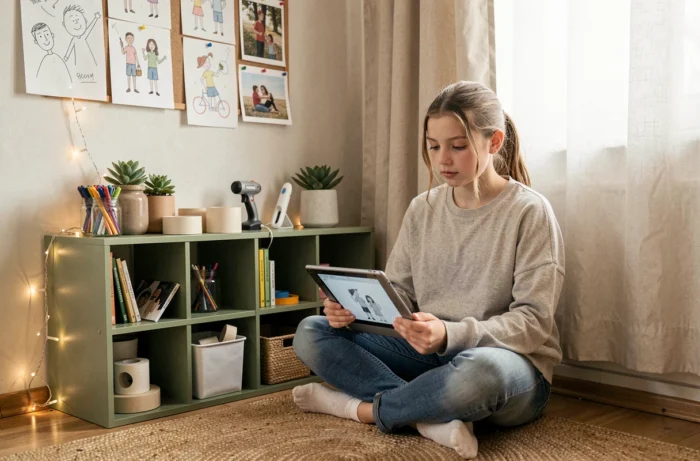
An interior designed for creativity does not resemble a decor trend showroom. It resembles a place where air circulates, where light changes throughout the hours, where each resident can adapt their space to what they are doing. Home innovation starts with measurable adjustments, not a style change.