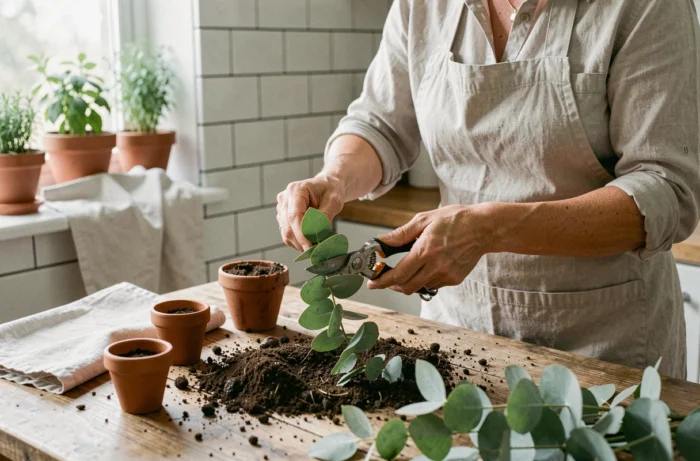
The propagation of eucalyptus shows a significantly lower success rate compared to other common shrubs. A study conducted at the Federal University of Santa Catarina on Eucalyptus benthamii observed only one rooted cutting out of 72, despite various substrates and different hormone doses. The survival of the stems remains acceptable (between 50% and 81.2% depending on the substrates), but adventitious rooting poses the real problem. Five parameters, when mastered together, significantly increase the chances of success.
1. Choose the right time and the right stems for propagating eucalyptus
The timing of the cuttings affects the rooting ability more than any other mechanical factor. Semi-woody stems, neither too young nor too rigid, concentrate the necessary reserves for the formation of adventitious roots. They can be recognized by their color: the base begins to brown while the tip remains green and flexible.
Take cuttings at the end of spring or the beginning of summer, when vegetative growth is active. A stem from the current season, about fifteen centimeters long, with at least two leaf nodes, is the suitable starting material. Remove the leaves from the lower third to limit evapotranspiration and expose the nodes where roots can emerge.
Not all eucalyptus species respond in the same way. Some ornamental varieties like Eucalyptus gunnii are more cooperative than forest species like E. benthamii. The choice of species weighs as much as the technique itself. To successfully propagate eucalyptus cuttings, it is better to start from a young, vigorous mother plant than from a mature tree whose tissues lignify quickly.
2. Prepare the ideal substrate for rooting the cutting
The substrate must fulfill two contradictory functions: retain just enough moisture without causing rot. A draining mixture of equal parts peat (or coconut fiber) and perlite meets this requirement. Vermiculite can replace perlite, but it retains more water, increasing the fungal risk on already fragile stems.
Moisten the substrate before inserting the cutting. A dry substrate at the time of planting creates air pockets around the stem and prevents the necessary contact between the cambium cells and the medium. Firm it slightly without compressing, then water again on the surface.
| Component | Main Role | Risk if Excess |
|---|---|---|
| Peat or coconut fiber | Moisture retention | Root asphyxiation |
| Perlite | Drainage and aeration | Rapid drying |
| Vermiculite | Water + mineral retention | Excess moisture, mold |
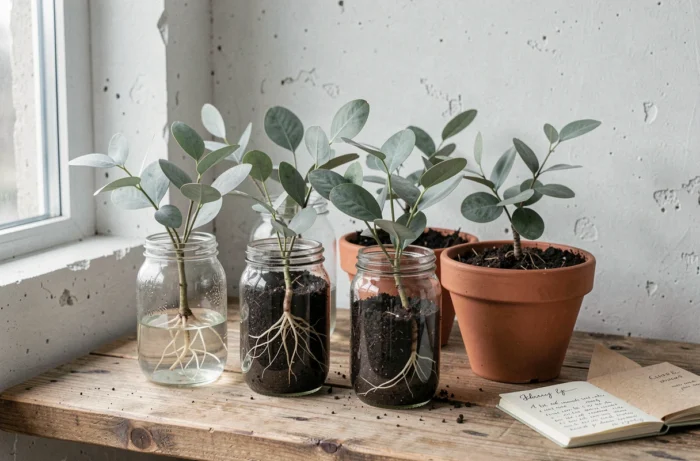
3. Apply rooting hormone to eucalyptus stems
Eucalyptus naturally produces few auxins at the nodes, which explains the difficulty in rooting. Indole-3-butyric acid (IBA) compensates for this deficit by stimulating cellular differentiation at the base of the stem. The powder form remains the easiest to dose for home use.
Dip the cut end about two centimeters into the hormone powder, then tap to remove the excess. An excess of hormone can cause tissue necrosis instead of promoting rooting. The Brazilian study on E. benthamii tested several concentrations of IBA without observing a significant difference in the rooting rate, suggesting that the dose matters less than the physiological state of the stem.
Natural alternatives exist (willow water, honey, cinnamon), but no published data demonstrates their specific effectiveness on eucalyptus. For a species that is already recalcitrant, synthesized IBA remains the most documented choice.
4. Control humidity and light for eucalyptus cuttings
The eucalyptus cutting needs an environment that is both humid and bright, but without direct sunlight. Bright indirect light prevents drying while maintaining the photosynthetic activity of the remaining leaves. Place the pot near an east or north-facing window, or under a filtering horticultural cloth.
To maintain high humidity, cover the pot with a transparent plastic bag or a dome. This mini-greenhouse effect limits leaf transpiration and keeps the substrate moist longer. Two precautions to follow:
- Open the dome or bag once a day for a few minutes to renew the air and avoid stagnant condensation
- Watch for the appearance of white or gray mold on the surface of the substrate, a sign of excess moisture combined with a lack of aeration
- Maintain a gentle temperature around 20 to 25 °C, the recommended range to avoid both drying and rot
A heating mat placed under the pot can help stabilize the substrate temperature, especially in air-conditioned interiors where day-night temperature fluctuations hinder rhizogenesis.
5. Ensure good aeration to avoid fungal diseases
Aeration is the parameter that gardeners underestimate the most in eucalyptus propagation. A confined and moisture-saturated environment promotes the development of Botrytis and other pathogenic fungi that destroy the base of the stem before any root formation.
Ventilating the mini-greenhouse daily for five to ten minutes is enough to renew the atmosphere without drastically lowering humidity. If you use a plastic bag, poke two or three small holes at the top to create passive circulation.
The substrate itself contributes to aeration. A mixture that is too compact or too rich in fine organic matter (pure potting soil, compost) retains excess water and deprives the tissues of oxygen. Perlite or coarse sand incorporated into the mixture ensures that air circulates to the cutting area.
After four to eight weeks, test the resistance of the stem by gently pulling. A slight resistance indicates the beginning of rooting. If the stem comes out effortlessly, extend the culture under the dome while adjusting aeration. Patience remains the final determining factor: for a species where natural rooting sometimes approaches a symbolic percentage, every additional week counts.